

Last month, we explored the growing cyber security threats facing B2B businesses. This month, we’re looking at a connected challenge: operational resilience and why the systems holding your business together matter more than most leaders realise.
The Cost of Going Down
Disruption is no longer an edge case. A 2025 survey by Cockroach Labs found that 100% of organisations surveyed experienced outage-related revenue losses in the previous 12 months, with the average organisation suffering 86 outages annually. That’s more than one a week.
The financial consequences are significant at every level. For smaller businesses, research puts downtime costs at around £427 per minute. For mid-size enterprises, ITIC’s 2024 Hourly Cost of Downtime report found that over 90% estimated losses exceeding $300,000 per hour and 41% put that figure at $1 million or more. For UK businesses specifically, a Samsung study found that SMEs lose close to £300,000 annually due to unreliable or outdated technology alone.
These figures don’t include the less visible costs: client relationships strained by delays, staff hours lost to workarounds, or the erosion of trust when your systems don’t perform.
Where the Pressure Points Are
Understanding where resilience breaks down is the first step in addressing it. Across the B2B sector, the picture is consistent. Network and connectivity issues are now the single biggest cause of IT outages, accounting for 31% of incidents according to Uptime Institute’s 2024 research. Human error, often the result of overly complex manual processes, follows closely behind.
For businesses operating in B2B e-Commerce specifically, the risks compound. Research shows that 26% of businesses operate with only partially integrated e-Commerce systems, meaning orders, inventory, and pricing data often require manual reconciliation between platforms. When systems don’t communicate, someone fills the gap, and that person becomes a single point of failure.
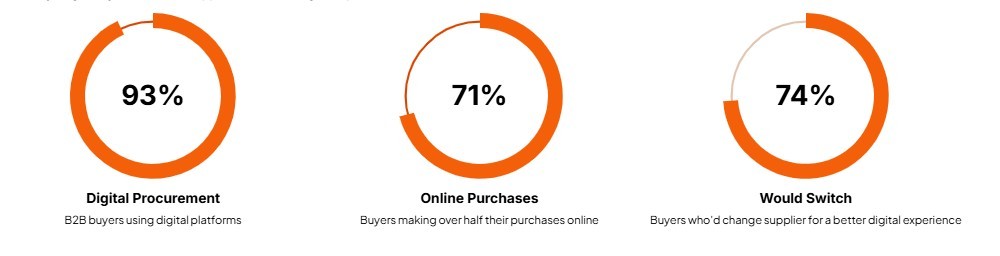
The buyer landscape is shifting too, which raises the stakes. Today, 93% of B2B buyers use digital platforms for procurement, and 71% make more than half of their purchases online. These clients expect accurate information, reliable availability, and seamless ordering. Businesses that can’t deliver consistently, because their back-end systems aren’t aligned, are at genuine risk of losing them: research from Shopify indicates that 74% of B2B buyers globally would switch supplier for a better digital experience.
______
Supply chain resilience has a security dimension that most businesses underestimate our deep dive into security in supply chain automation covers the specific vulnerabilities that hit B2B businesses hardest and what good protection actually looks like.
For many B2B businesses, the resilience gap comes down to systems that were never properly connected the real cost of a DIY integration approach explores why that decision tends to compound over time.
Why Infrastructure Decisions Are Strategy Decisions
There’s a tendency to treat technology infrastructure as an operational issue, something for IT to manage rather than leadership to prioritise. The data suggests otherwise.
Businesses still relying on manual integration between their e-Commerce platforms and ERP or procurement systems face a compounding set of risks: data inconsistencies, slower order processing, higher error rates, and limited ability to scale. One analysis found that companies spending heavily on custom-built or patchwork systems can end up allocating as much as 40% of their technology budget just to maintaining in-house custom-built systems, with little resource left for improvement.
Resilient businesses, by contrast, run on infrastructure that’s designed to be maintained, updated, and scaled without disruption. Cloud-based, well-integrated systems remove the dependency on individual knowledge holders, reduce manual intervention, and create a more stable foundation for growth.
Where GetConnect Fits In
For businesses operating in B2B eCommerce, one of the most common resilience gaps is the connection between your eCommerce platform and your ERP or procurement systems. When those systems aren’t properly integrated, the gaps get filled with manual processes, workarounds, and people-dependent fixes. That’s a fragile foundation.
GetConnect’s integration platform is designed to remove exactly that fragility. By creating reliable, maintained connections between your eCommerce environment and your clients’ procurement systems, including Punchout catalogue support and ERP integration, it reduces the manual touchpoints that introduce errors and delay. When your client changes their procurement setup, or your platform is updated, the integration holds. You’re not starting from scratch, and your team isn’t left scrambling.
It’s a practical example of what resilient infrastructure actually looks like in a B2B e-Commerce context: fewer dependencies on individual knowledge holders, more consistent data flowing between systems, and a setup that can scale without proportionally increasing the risk of things going wrong.
A Note for Next Month
Next month, we’ll be looking at what it means to maximise your eCommerce portal: how businesses move from simply being online to actively driving growth through their digital channels. The starting point for that conversation is always the same: a stable, integrated foundation that can support what comes next.
If you’re thinking about the resilience of your current setup, it’s a useful moment to audit where your manual processes are, where your systems don’t connect, and what that’s costing you in time and resource, before it becomes something more significant.
Sources
- Cockroach Labs, The State of Resilience 2025: Confronting Outages, Downtime, and Organisational Readiness (2025)
- ITIC, 2024 Hourly Cost of Downtime Report (2024)
- Samsung / Twenty-Four IT, The True Cost of IT Downtime (2024)
- Uptime Institute, 2024 Data Centre Resiliency Survey (2024)
- CommerceBuild, Why ERP-Led Businesses Struggle Online (2025)
- B2B e-Commerce Association, The Definitive Guide to B2B e-Commerce Buyer Demands (2024)
- Shopify, B2B e-Commerce Challenges in 2025 (2025)
- DivergIT, The True Cost of IT Downtime for Businesses (2024)
For more information on how GetConnect can help your business email us at help@getconnect.net. or call 03332407426.